Methodology & Provenance — GM RPO Code Reference
This document records how the RPO reference in docs/rpo/ was
assembled, so the authority of any individual code can be judged and
defended. It is the basis for canonical relevance: a claim's weight is
a function of its source tier and how many independent sources confirm it,
both of which are tracked per code.
Compiled 2026-07-12. Scope: classic-era GM vehicles, model years 1960–1982, seven divisions (Chevrolet passenger cars, Corvette, Chevrolet/GMC trucks, Pontiac, Oldsmobile, Buick, Cadillac).
1. Source tiers (canonical hierarchy)
Every code traces to a source in one of these tiers. Tier is what makes a code canonical vs. corroborating vs. provisional.
| Tier | Definition | Examples | Canonical weight |
|---|---|---|---|
| T1 — Factory primary | GM's own documents: Vehicle Information Kits / dealer order guides, factory optional-equipment tables | GM Heritage Archive kit PDFs (OCR'd, see §4); factory billing records via PHS | Authoritative. A T1 code is canonical on its own. |
| T2 — Records-based enthusiast | Compilations built directly from GM production records or factory paperwork by recognized marque authorities | Camaro Research Group (camaros.org); chevellestuff.net per-year matrix; Corvette Action Center; NCRS |
Near-authoritative. Treated as canonical when it agrees with or substitutes for T1. |
| T3 — Community compilation | Club sites, registries, and enthusiast databases without a stated factory-records chain | nastyz28.com, novaresource.org, 442.com/mirrors, 78ta.com, TeamBuick, CorvSport |
Corroborating. Confirms a code but does not establish it alone. |
| T4 — General reference | Encyclopaedic or editorial context | Wikipedia, magazine articles (Hemmings, Hagerty, MotorTrend) | Context only. Never a sole source for a code. |
The per-code Confidence column encodes the outcome of applying this hierarchy:
confirmed— 2+ independent sources agree, or one T1/T2 source carries it. This is the canonical set.single-source— only one source, and it is T3/T4. Provisional; a candidate for promotion when a factory kit (§4) is mined.disputed— sources conflict. Both readings are recorded verbatim with their sources so the disagreement is visible, never silently resolved.
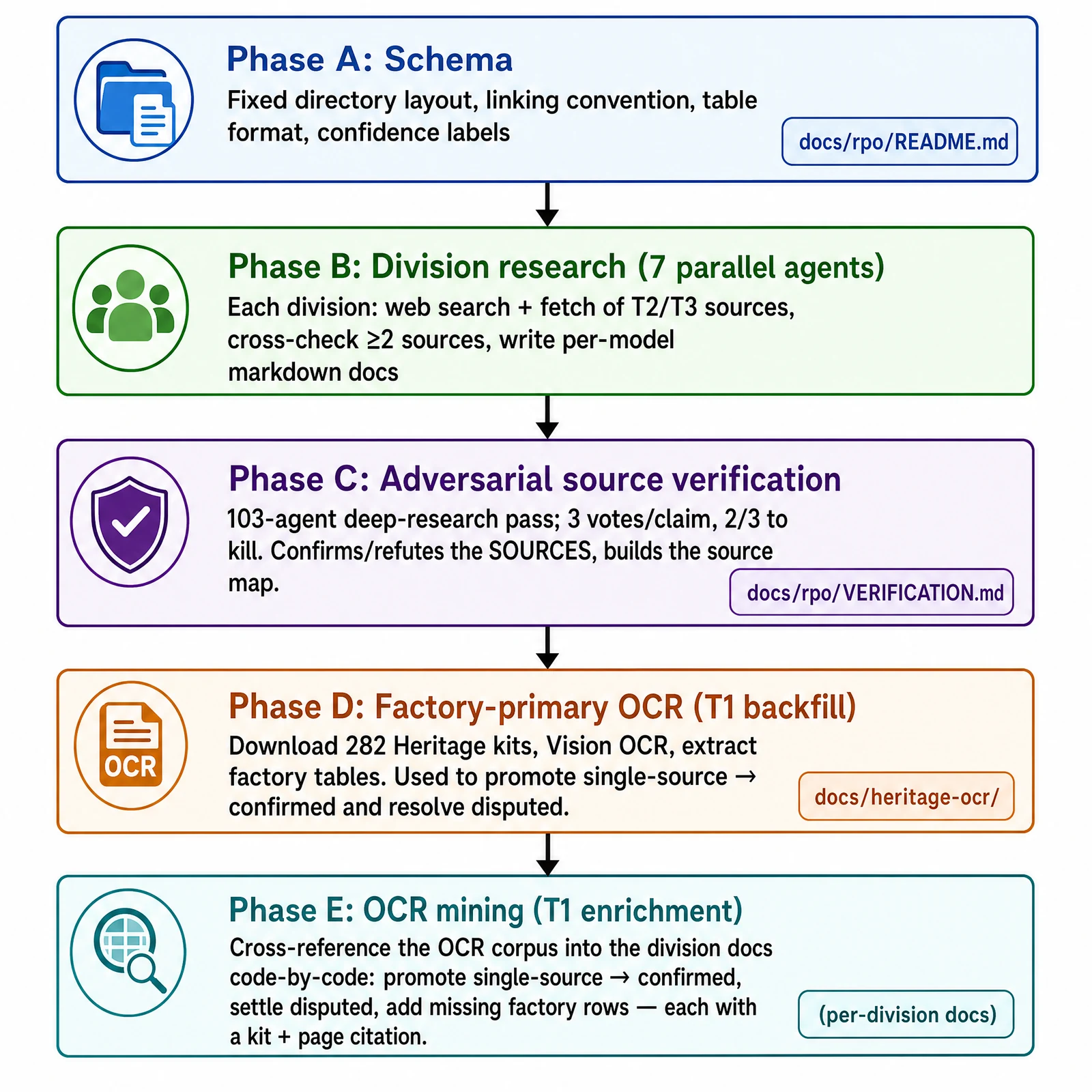
2. Pipeline overview
3. Phase B — Division research
Seven independent research agents ran in parallel, one per division grouping. Each was briefed with the same schema and the same standing rules:
- Use live web search + page fetch. Where a fetch was blocked (bot walls, expired certs, dead domains), fall back to raw HTTP or the Wayback Machine, and record the workaround rather than dropping the source.
- Cross-check every code against at least two independent sources where possible; set the Confidence label honestly.
- On conflict, record
disputedwith both readings — never pick silently. - List every source URL used, at both the division and per-model level.
- Flag coverage gaps explicitly rather than papering over them.
Output: 36 markdown documents (≈5,300 code rows). Each per-model doc
carries YAML frontmatter (division, model, model_aliases, years)
and #year-YYYY anchors so a decoded vehicle links to its exact section.
Provenance is preserved inside each document — every doc ends with a
Sources section listing what was actually used for that model, and the
master bibliography (SOURCES.md) aggregates all of them with access
notes (e.g. 442.com is dead and was read via its classicoldsmobile.com
mirror; AutomotiveMileposts resolves only through the Wayback Machine).
4. Phase C — Adversarial source verification
The sources themselves were then audited, because a compilation is only as canonical as the sources it rests on. A 103-agent research workflow extracted falsifiable claims about each candidate source and subjected each to three independent verification votes; a claim needed 2 of 3 refutes to be killed.
Result: 25 claims adjudicated — 21 confirmed, 4 refuted. This is what
fixed the source tiers in §1. Notable outcomes, all recorded in
VERIFICATION.md:
- Confirmed the GM Heritage Archive as the T1 anchor, and that it
relocated from
gmheritagecenter.comtogm.com/heritage/archive(906 kits). Confirmed CRG and chevellestuff as T2 via code-by-code spot checks. - Refuted CorvSport's claim of complete per-year Corvette coverage (failed 0–3) — demoting it to T3 corroboration, not a standalone source.
- Refuted the claim that PHS covers 1960 — it is 1961–1986 only.
- Established that the Heritage Archive holds zero Pontiac, Buick, or GMC kits, which is why those divisions have no T1 backing and remain the structurally weakest (Buick/GMC have no verified archival source online at all; GM directs Buick records to the Alfred P. Sloan Museum).
5. Phase D — Factory-primary OCR (T1 backfill)
The Heritage kits are image-only PDF scans with no text layer, so they had to be OCR'd to become machine-usable. This converts the reference from "best available enthusiast compilation" to "factory-verified" wherever a kit exists.
Corpus. The 906-kit index was filtered to model years 1960–1982, yielding 282 classic-era kits: Chevrolet cars 240, Chevrolet trucks 23, Cadillac 15, Oldsmobile 4. (Pontiac/Buick/GMC have none — see §4.)
Tooling. No OCR binaries were present on the machine, so a purpose-built
extractor (pdfocr, Swift + Apple Vision framework) was compiled locally.
Key settings, chosen for this document type:
- Pages rendered at 220 DPI to grayscale, then OCR'd.
- Recognition level accurate.
- Language correction disabled — critical, so option codes like
W-30,FE2,Z28are not "corrected" into dictionary words. - Output is plain text with
===== PAGE N =====markers, so any extracted code cites back to a page in the original kit.
Pipeline (run-ocr.sh, resumable, 4-way parallel): download kit →
OCR → write .txt → delete the PDF (only text is retained). Priority order
matched the gaps: Oldsmobile, then trucks, then Cadillac, then Chevrolet
cars. Downloads retry 3×; a kit whose .txt already exists is skipped, so
the run is safely restartable.
Validation. Pilot on the 1970 Oldsmobile 442 kit (339 pages, 38 MB) → 65 s, factory optional-equipment tables legible (W-30, W-31, FE2, C60 and their descriptions verified against the page images).
Storage. Extracted text lives in docs/heritage-ocr/<brand>/<kit>.txt
— deliberately outside docs/rpo/ to keep raw machine output separate
from curated markdown. It is citation backing (T1 evidence), not part of the
published reference.
Status: OCR complete — 282 of 282 kits extracted (Chevrolet cars 240, trucks 23, Cadillac 15, Oldsmobile 4), ~28,700 pages, 41 MB of text. Zero unrecovered failures; three transient gm.com download drops were retried successfully. Quality spot-checked across brands: 1965 truck order-guide codes (V43, K46, T60, P13, V05, Z61), 1963 Cadillac optional-equipment text, and 1969 Camaro codes (Z28, Z11, Z22, Z27, L78, L48, L35, JL8, D80) all extract cleanly.
5b. Phase E — OCR mining (T1 enrichment)
The OCR corpus is only evidence until it is cross-referenced into the reference. Phase E does that cross-referencing: five agents (one per kit-backed scope — Chevrolet cars, Corvette, Chevrolet/GMC trucks, Cadillac, Oldsmobile) worked their division docs code-by-code against the matching kit text. Pontiac, Buick, and car-side GMC have no kits (§4), so they are untouched by this phase and keep their T2/T3 confidence.
Per-code rule, applied conservatively to avoid importing OCR noise:
- A code is acted on only when the kit text shows the code token and a
plausible matching description on/near the same line; the page is read
from the nearest preceding
===== PAGE N =====marker. - Promote — a
single-sourcecode the kit confirms becomesconfirmed. - Resolve — a
disputedcode the kit settles becomesconfirmedwith a(factory kit resolves: …)note. - Fill — a factory code absent from the doc for a kit-covered
year/model is added as a new
confirmedrow. - Garbled OCR, or any code that can't be matched to a description and page, is left unchanged. No code or page number is ever fabricated.
Citation convention. Every row touched in Phase E carries a factory citation token in its Models/Notes cell:
<span class="doc-cite">⛭ GM Heritage — <brand>/<kit-file>.txt p.N</span>
HK = Heritage Kit. This points at the exact OCR file and page, which in
turn corresponds to a page in the original factory PDF — so a confirmed
code can be audited all the way back to the factory document. Each doc
touched also gains a ### Factory kits (T1) subsection in its Sources
listing the kit files used.
Outcome. Five agents (Chevrolet cars, Corvette, Chevrolet/GMC trucks,
Cadillac, Oldsmobile) enriched 14 documents with 2,514 factory <span class="doc-cite">⛭ GM Heritage — …</span>
citations keyed to specific kit pages. Aggregate effect:
- 130+
single-sourcerows promoted toconfirmed— heaviest in Cadillac 1960–66 (whole line-wide tables, e.g. all 24 rows of 1960) and Chevrolet cars (67) and Corvette. - ~19
disputedrows resolved against factory text, including: 1966 Corvette L72 (5,258 built @ 425 hp; the 450→425 change was to the rating), 1972 Corvette ZR2 (kit flags "Not to be merchandised" — never sold), the 1971–72 optional axle code (ZQ9, not ZQ1), truck N33/N34 (doc had the Sports-Styled/Comfortilt steering wheels swapped), truck tinted-glass codes (A09/A11, not A01/A02), and 1964 Cadillac filler plate (F, not FP). - ~100 new
confirmedfactory rows, concentrated in the previously empty 1960–66 Chevrolet truck order-guide gap (rebuilt from one 21-row table to ~90 factory-cited rows) and Oldsmobile 442. - 1 new dispute surfaced: the 1968 Cadillac shoulder-belt codes (kit reads Z = rear / H = front-convertible, contradicting the doc) — flagged for a second source rather than overturned on a single OCR read.
Conservatism held throughout: homoglyph misreads (O/0, I/1, S/5) and SAE spec-page labels were excluded, ambiguous candidates skipped, and codes with no kit support (e.g. truck K05) downgraded — the pass removed unsupported confidence as well as adding it.
6. Using this for canonical relevance
To judge or defend any code in this reference:
- Find the code's row; read its Confidence and the doc's Sources.
- Map each source to its tier (§1). A
confirmedcode backed by T1 or T2 is canonical. Asingle-sourceT3 code is provisional. - For provisional or
disputedcodes, checkdocs/heritage-ocr/for the matching year/model kit — a factory table there is T1 and settles it. A row already carrying a<span class="doc-cite">⛭ GM Heritage — …</span>citation (Phase E, §5b) has been audited to that factory page. VERIFICATION.mdrecords which sources have been audited and how they voted;SOURCES.mdrecords where each source lives and how to reach it.
The chain for any claim is therefore: code row → confidence + named source → source tier → (if needed) factory kit page. Nothing in the reference is asserted without a traceable position in that chain.
7. Reproducibility & next round
The assembly is re-runnable. The division research briefs, the verification
workflow, and the OCR pipeline (run-ocr.sh + pdfocr.swift) are all
preserved, as are the Phase E mining briefs. Highest-value follow-ups, in
order:
Mine the OCR corpus into the division docs.Done — Phase E (§5b).- Recover Pontiac/Buick/GMC kits (if any) from Wayback captures of the old
gmheritagecenter.comsite — the current archive dropped those brands. These three divisions have no T1 backing until such kits are found. - Add NCRS as the per-year Corvette T2 source (replacing CorvSport's refuted completeness claim).